
There are some dishes I look forward to making every Chauti, and Padengi Thetla da Gassi is one of them. Sprouting the moong, softening the leaves enough to tie them into knots, lightly pounding the ambade. The preparation itself feels therapeutic, before everything comes together in that earthy coconut masala.
It is a family favourite from our festive spread of Ashtami and Chauti. The sprouted moong, the dense bite of the leaf knots and the tartness of the hog plums each bring something different to the pot. Through the rest of the year, we make Padengi Gassi without the knots and ambade. Adding those two makes this version feel like a festival.
Making it here, I miss the fresh produce from our sabzi mandi. For the version in my reel, I used the plastic-wrapped leaves I could find at the Asian supermarket and replaced the hog plums with amrella. Sometimes the ingredients need a little adapting, but this is still the curry I want on my leaf lunch.
And then there is breakfast the next morning. I love this Gassi with Kottiges. Amma and Mom would also mix the leftover festival curries together, our own version of Gajbaje, to eat with them. That mixed curry has a flavour of its own, one that is difficult to explain but so easy to remember.
This recipe was also published in a newspaper. I am happy to keep it here too, alongside the memories that belong to it.
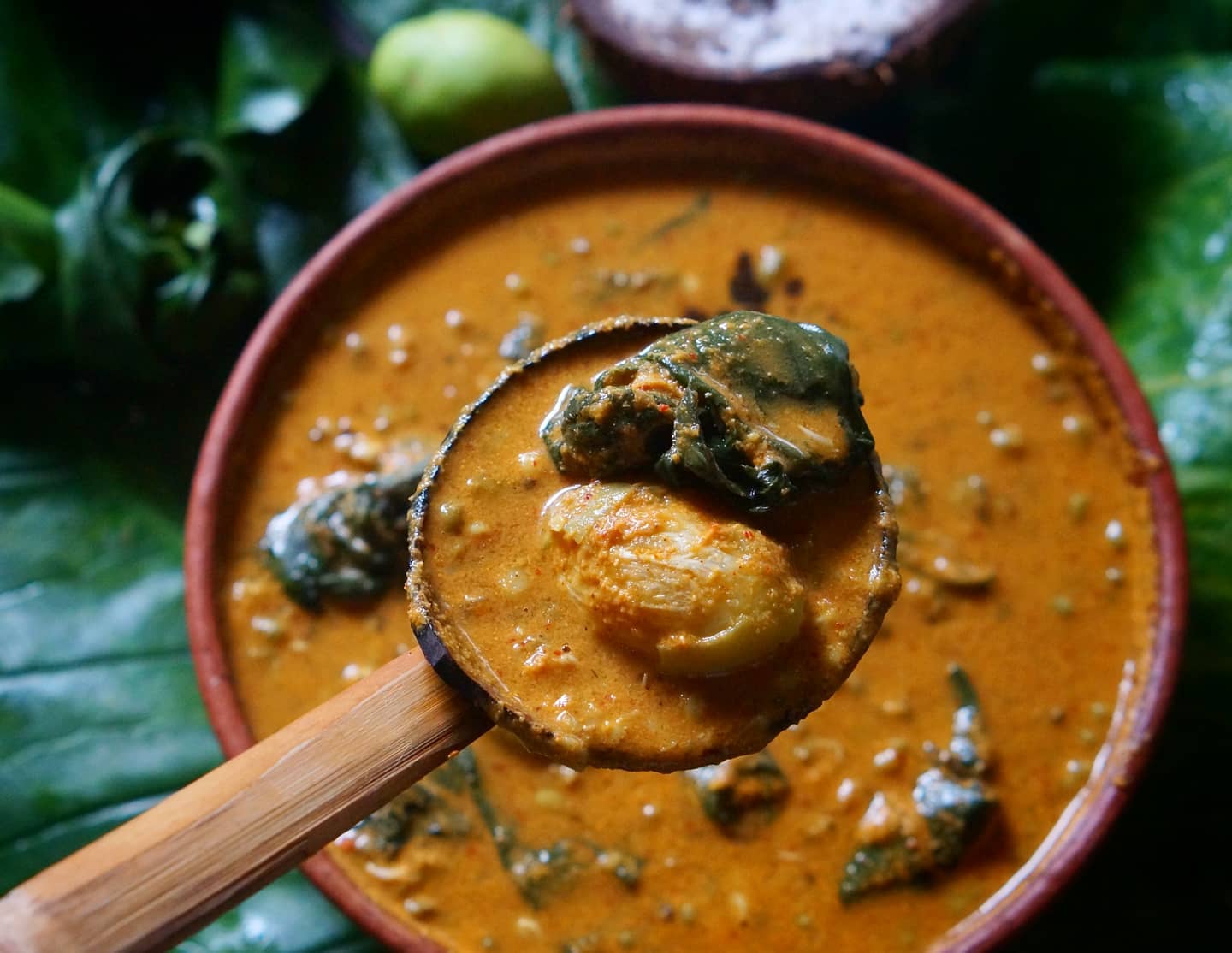
Padengi Thetla da Gassi
Ingredients
For the curry
- 1 cup sprouted whole green moong (padengi), measured after sprouting
- 1½ cups colocasia leaf knots (thetla), made from edible colocasia leaves, also called Tevu da Ire or Alu Pata
- 2 to 3 hog plums (ambade), lightly pounded
- Salt, to taste
- Water, as needed for cooking and adjusting the curry
- A little extra tamarind, for boiling the leaf knots
- A little turmeric, for the leaf-preparation water
For the coconut masala
- ½ a fresh coconut, grated
- 5 to 6 dried Byadgi chillies
- 1 marble-sized ball of tamarind
- 1 teaspoon cumin seeds
- 1½ tablespoons coriander seeds
- ½ teaspoon turmeric powder
- Water, just enough to grind
For the tempering
- 1 teaspoon coconut oil
- 1 teaspoon mustard seeds
- 5 to 6 curry leaves
Instructions
Method
- Prepare the leaves. Wash the colocasia leaves and remove the stalks and tougher veins. Save the stalks for Dant da Kajipu. Soak the prepared leaves in water with a little turmeric, then drain and leave them for around 2 hours to wilt slightly. They should become limp enough to roll without tearing.
- Make the leaf knots. Roll each softened leaf into a narrow length and gently tie it into a knot. For a visual guide, see my linked reel. Measure 1½ cups of the prepared knots.
- Cook the knots. Place them in a pot with water, a little tamarind and salt. Boil until the leaves are thoroughly cooked and tender, including the centre of each knot. Keep the knots aside.
- Cook the moong and ambade. Lightly pound the hog plums. Pressure-cook them with the sprouted moong and enough water for one whistle, then allow the pressure to release before opening. Check that the moong is tender and cook further if needed. Reserve its cooking water.
- Grind the coconut masala. Grind the fresh coconut, Byadgi chillies, tamarind, cumin, coriander and turmeric into a fine paste, adding only enough water to help the mixer along.
- Make the tempering. Heat the coconut oil in a pot. Add the mustard seeds and let them splutter, then add the curry leaves.
- Bring the curry together. Pour in the ground masala and add salt. Stir in the cooked moong, leaf knots and hog plums. Thin the curry with the moong cooking water or fresh water until it reaches the consistency you like.
- Boil and simmer. Bring everything to a boil, then simmer gently for a few minutes until the masala is cooked through and the flavours come together. Taste and adjust the seasoning. Stir gently to keep the knots intact.
- Serve. Enjoy with rice as part of a leaf lunch, or with Kottiges.
Notes
- One cup of sprouts, rather than one cup of dry moong. The recipe quantity is measured after sprouting. Have the sprouts ready before starting the curry.
- Half a coconut means half the coconut, grated. It is not the ½ cup coconut quantity from Dant da Kajipu.
- Ambade make this festive version special. I used amrella when hog plums were unavailable for the reel. Adjust the tamarind to suit the sourness of the fruit available.
- Let the leaves soften before rolling. The slight wilting makes knotting easier. It does not replace thorough cooking.
- This is its own masala. The recipe uses coconut, Byadgi chillies, tamarind, cumin, coriander and turmeric, with a mustard and curry-leaf tempering.
Watch my leaf-knot preparation and curry reel.
For more from our family kitchen, try Kembude Da Gassi and Temple-style Saar.
